
La Vara
La Vara of Messina
Five Centuries of History
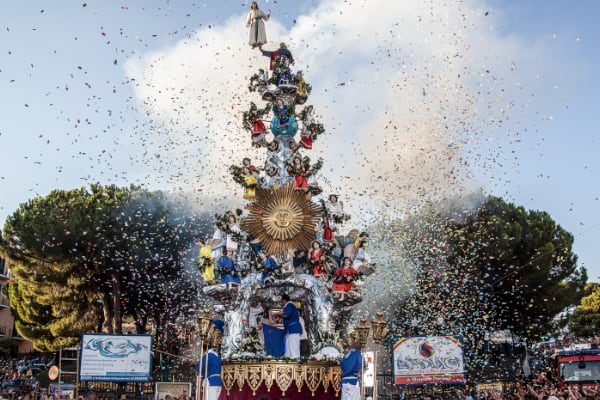
When the Assumption Touches the Sky
Every 15th of August, Messina comes to a standstill. Over a thousand barefoot devotees pull a majestic, 13.5-meter-tall votive machine weighing nearly 8 tons through the city center: this is the Vara, the beating heart of the Feast of the Assumption and one of Europe’s most breathtaking folk rituals. It is more than a procession—it is the very soul of the city taking to the streets, every year, for nearly five centuries.
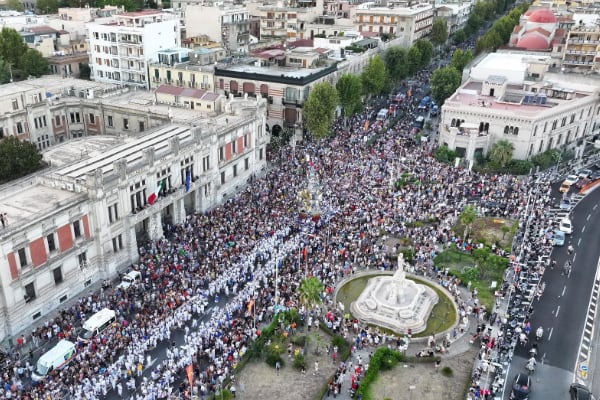
How Messina Experiences the Day
On the 15th of August, Messina comes alive with pilgrims, tourists, and locals returning home just for the occasion. Along Via Garibaldi, the crowd gathers to follow the passage of the giant votive structure with songs and applause, in an atmosphere where deep-rooted devotion seamlessly blends with vibrant celebration. It is also the perfect time to discover the city’s other iconic landmarks—from the Cathedral with its world-famous astronomical clock to a scenic stroll along the Strait of Messina.
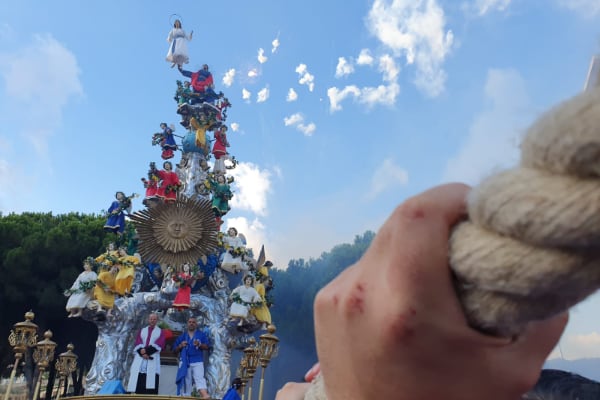
Experience the Procession
If you wish to witness the Vara, we highly recommend arriving at Via Garibaldi or Piazza Duomo well in advance: the turnout is massive, and several streets are closed to traffic. Make the most of your day by also exploring the rest of the historic city center and the beautiful coastline of the Strait of Messina.
Five Centuries of History
The Vara was created in 1535 on the occasion of the visit to Messina of Emperor Charles V of Austria, following his victories in Tunis and La Goletta against the corsair Barbarossa.
On September 19th of that year, the Senate of Messina decided to build the 'machina della Vara' for the sovereign’s grand entry into the city, scheduled for October 21st. For this special occasion, the figures representing Christ and the Soul of the Virgin Mary were replaced in tribute to the Emperor with Charles V himself and a winged Victory holding a laurel branch.
Since then, almost every year, the structure has returned to its original design dedicated to the Assumption of the Virgin Mary, enduring through five centuries of local history. It was admired by Don John of Austria in 1571 upon his return from the Battle of Lepanto, as well as by generations of viceroys and foreign travelers. Among them were the French painter Jean-Laurent Houël, who left one of its most detailed descriptions in 1776, and the British Royal Navy Captain William Henry Smyth, who documented it in 1824 in a volume featuring a fine engraving. As early as 1591, the jurist Giuseppe Carnevale defined it as one of the most beautiful and magnificent things in the world for its height, scale, and craftsmanship.
A Special Documentary by the Municipality of Messina
Curated by the Department of Culture and Tourism

VisitME Messina
Tourism Brand of the City of Messina. Curated by the Department of Tourism of the City of Messina.